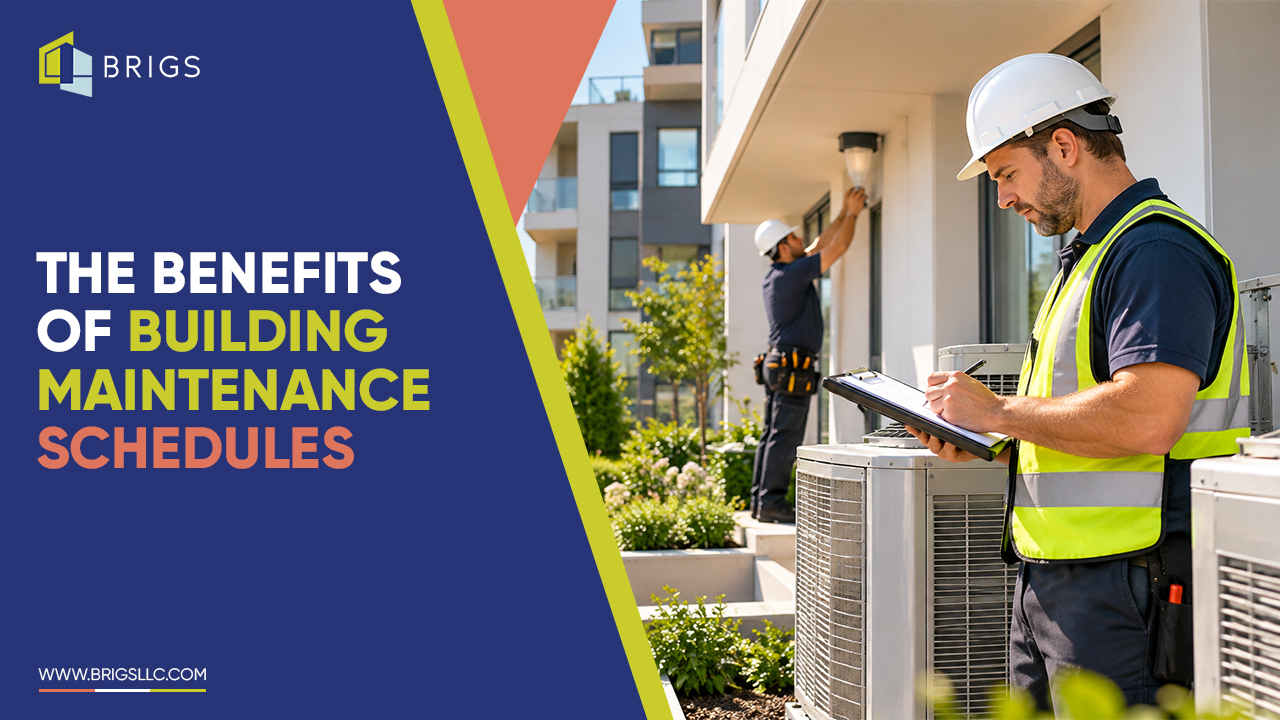
Keeping a property in good condition requires more than responding when something breaks. Buildings are made up of interconnected systems and components that require regular inspection, servicing, repair, and eventually replacement. Without a structured approach to maintenance, important tasks can easily be delayed or overlooked until a relatively manageable issue becomes a more expensive problem.
A building maintenance schedule provides that structure.
For condominium associations, HOAs, and multi-family properties, a maintenance schedule establishes when important building systems and common areas should be inspected or serviced throughout the year. Depending on the property, that may include roofing, HVAC equipment, elevators, plumbing systems, fire protection equipment, generators, drainage systems, parking areas, landscaping, building envelopes, common areas, and many other components.
The objective is not simply to create a calendar of maintenance tasks. An effective schedule helps management develop a more proactive understanding of the property’s physical condition and anticipate what may require attention next.
Without that structure, property maintenance can become heavily reactive. A roof receives attention when a leak develops. HVAC equipment is serviced when it stops operating properly. Drainage problems are addressed after water begins accumulating. Pavement receives attention after deterioration becomes difficult to ignore.
Reactive maintenance will always be necessary to some extent because unexpected problems occur in every property. However, relying too heavily on that approach can make a building more expensive and difficult to manage.
Regularly scheduled maintenance gives property managers an opportunity to identify developing conditions before they result in significant failures.
A roof inspection, for example, may identify deteriorated flashing, damaged membranes, clogged drainage areas, or other conditions that can be addressed before they contribute to water intrusion. Routine HVAC service may identify worn components or performance problems before equipment fails during periods of peak demand. Regular inspections of exterior building components may reveal deterioration that should be evaluated before it becomes more extensive.
In each case, the value of the maintenance schedule comes from creating an opportunity to act earlier.
This can have significant financial implications.
A relatively minor maintenance issue is often less expensive to address than the damage that can occur when it is ignored. Water provides one of the clearest examples. A small roofing, plumbing, or building-envelope issue may initially require a limited repair. If the underlying condition continues, it can potentially contribute to damage involving walls, ceilings, flooring, insulation, electrical components, or multiple residential units.
The cost is no longer limited to fixing the original problem.
A consistent maintenance schedule can reduce the likelihood that preventable conditions reach that point.
Preventive maintenance can also help extend the useful life of major building components. Mechanical equipment that receives appropriate servicing may operate more reliably than equipment that receives attention only after a problem develops. Roofs that are inspected and maintained can have minor deficiencies addressed before those conditions contribute to broader deterioration. Pavement, drainage systems, and exterior components can similarly benefit from regular attention.
This does not eliminate eventual replacement. Every major building component has a finite useful life.
Instead, the goal is to protect the association’s investment and obtain as much appropriate service life as possible before replacement becomes necessary.
Maintenance schedules also create consistency.
Property management involves hundreds of recurring responsibilities, and many important maintenance tasks occur only once or twice each year. Without a formal schedule, those responsibilities can become dependent on individual memory. That creates unnecessary risk, particularly when board members change, management personnel transition, or vendors are replaced.
A documented maintenance schedule establishes a process that can continue regardless of who is currently involved.
The property knows when the roof should be inspected. Management knows when seasonal HVAC service should occur. Fire protection inspections can be coordinated according to required intervals. Drainage systems can be reviewed before seasons when heavy precipitation is more likely. Exterior areas can be evaluated after winter weather.
Over time, this creates something equally valuable: a maintenance history.
Instead of simply knowing that a system has been serviced, management can document when the work occurred, what was inspected, what conditions were identified, what repairs were recommended, and what actions were ultimately taken.
That historical information can significantly improve future decision-making.
Suppose an HVAC system begins requiring increasingly frequent repairs. A detailed maintenance history allows management and ownership to review how often problems have occurred, what has been repaired, how much has been spent, and whether the frequency or severity of service issues is increasing.
At some point, the conversation may need to shift from maintaining the existing system to planning for replacement.
A maintenance schedule can help that transition happen intentionally rather than during an emergency.
This connection between maintenance and capital planning is particularly important for condominium associations and HOAs. Many of the components being maintained today will eventually become capital projects. Roofs, elevators, mechanical systems, pavement, building exteriors, and other major assets require substantial investment over the life of a property.
Regular maintenance provides information about how those assets are actually performing.
A reserve study may estimate that a component has a certain remaining useful life, but real-world conditions can change. A system may deteriorate faster than expected, while another may remain in good condition longer than originally projected. Maintenance records, inspections, and professional evaluations can help boards refine their assumptions as conditions evolve.
That allows the maintenance schedule and long-term capital plan to support one another.
Maintenance schedules can also improve vendor accountability.
When recurring service requirements are clearly documented, management can verify that contractors are performing the work expected under their agreements. If an HVAC contractor is supposed to service equipment quarterly, there should be a record of those visits. If a roof inspection identifies recommended repairs, management can track whether those repairs were completed. If an elevator contractor repeatedly identifies the same problem, that information can be reviewed as part of the broader service relationship.
This creates a more disciplined approach to vendor management.
Rather than assuming routine work is occurring because a contract exists, management can confirm that scheduled services are actually being completed and documented.
For boards and property owners, this creates greater visibility into what is being done to protect the property.
A significant amount of good property management happens before residents ever notice a problem. Preventive maintenance is one of the clearest examples. When equipment is serviced, drains are cleared, roofs are inspected, and minor deterioration is repaired early, there may be no dramatic result for residents to see.
That is precisely the point.
The best maintenance problem is often the one that never becomes an emergency.
Building maintenance schedules help make that possible by replacing a purely reactive approach with a repeatable system for inspecting, maintaining, documenting, and evaluating the physical components of a property.
They also make maintenance easier to incorporate into budgeting. When recurring tasks are known in advance, their anticipated costs can be included in the operating budget rather than appearing as unexpected expenses throughout the year. Management can review existing service contracts, anticipated inspections, seasonal work, and known preventive maintenance requirements while developing the property’s annual financial plan.
That creates a closer connection between the physical needs of the building and the financial resources required to address them.
A maintenance schedule should not be treated as a static document, however.
Buildings change. Equipment ages. New systems are installed. Contractors make recommendations. Inspections uncover new conditions. Capital projects replace components that previously required different maintenance. The schedule should evolve along with the property.
Management should periodically review what is being maintained, whether service frequencies remain appropriate, what recurring issues have been identified, and whether additional inspections or preventive work should be incorporated.
The objective is to create an active maintenance strategy rather than a checklist that is simply repeated year after year.
For boards and property owners, that distinction matters.
A building maintenance schedule is ultimately more than an operational tool. It can help reduce preventable emergencies, control long-term repair costs, improve vendor accountability, strengthen budgeting, preserve building systems, and provide better information for future capital planning.
Most importantly, it encourages management to ask a different question.
Instead of waiting to ask, “What needs to be repaired today?”
A proactive maintenance program asks, “What should we be doing today to reduce the likelihood of a larger problem tomorrow?”
That shift is one of the foundations of effective long-term property management.
One of the greatest benefits of a building maintenance schedule is the ability to identify and address potential problems before they become emergencies. Emergency repairs are often among the most disruptive and expensive situations a property can face because they require immediate action, provide little time to evaluate alternatives, and can result in additional damage when a problem is not discovered early.
A failed piece of equipment, significant water leak, drainage problem, or building-envelope issue rarely occurs at a convenient time. When something fails unexpectedly, management may need to contact whichever qualified contractor is available, authorize emergency work, coordinate access to affected areas, communicate with residents, and determine how the unexpected expense will be funded. Depending on the situation, the original failure may also create secondary damage that substantially increases the overall cost.
A structured maintenance schedule cannot prevent every emergency, but it can reduce the likelihood that preventable problems reach that stage. Regular inspections and servicing give property managers and vendors opportunities to identify deterioration, unusual operating conditions, worn components, recurring problems, and other warning signs before complete failure occurs.
Consider a roof that appears to be functioning normally from the ground. Without periodic inspections, deteriorated flashing, membrane damage, clogged drains, failed sealants, or other relatively small deficiencies may go unnoticed. If those conditions eventually allow water to enter the building, the association may be responsible not only for repairing the roof but also for addressing interior damage and other affected building components. Regular inspections provide an opportunity to identify and correct some of these conditions before water intrusion occurs.
Mechanical equipment provides another example. Boilers, HVAC systems, pumps, generators, and other equipment typically require ongoing servicing. Preventive maintenance allows technicians to inspect components, evaluate performance, perform recommended servicing, and identify developing issues. A worn component discovered during a scheduled service visit may be relatively straightforward to replace. The same component failing unexpectedly could result in equipment downtime, an emergency service call, and greater disruption for residents.
This is especially important for equipment that supports essential building operations. An HVAC failure during extreme weather, a malfunctioning domestic water system, or an elevator outage can quickly become more than a routine maintenance issue. Residents may be significantly affected, and management may have limited flexibility in determining how or when the repair is performed.
Scheduled maintenance creates more opportunities to address those needs under controlled circumstances.
That additional planning time can have a direct financial benefit. When a problem is identified before it becomes an emergency, management may have time to obtain multiple proposals, evaluate different repair options, confirm the appropriate scope, coordinate the work efficiently, and budget for the expense. Emergency conditions frequently eliminate some or all of those options because restoring service or preventing additional damage becomes the immediate priority.
The difference is not simply the cost of the repair itself. Emergency work can involve overtime rates, expedited materials, temporary equipment, remediation, additional contractor mobilization, resident accommodations, or secondary repairs resulting from the original failure. A problem that might have required a relatively limited planned repair can become considerably more expensive once circumstances require an emergency response.
Building maintenance schedules can also help management recognize recurring problems that may otherwise appear unrelated. If the same drain repeatedly backs up, the same section of roof requires frequent repairs, or the same mechanical equipment generates multiple service calls, the maintenance history can reveal that the property may be dealing with something more significant than isolated incidents.
At that point, continuing to make individual repairs may no longer be the most effective strategy. Management can bring the history to the board or property owner, consult the appropriate professionals, and determine whether a larger repair, replacement, or capital project should be considered.
This is an important distinction between reactive and proactive property management. Reactive management focuses primarily on restoring normal operations after something goes wrong. Proactive management attempts to understand why problems are occurring and what can be done to reduce the likelihood that they continue.
A maintenance schedule provides the structure necessary to support that approach.
Seasonal planning is another important part of reducing unexpected problems. Properties experience different maintenance demands throughout the year, and preparing for those conditions in advance can help management identify vulnerabilities before they are tested by severe weather or heavy usage.
Before winter, management may need to review heating equipment, exterior plumbing conditions, snow and ice management preparations, roofs, drainage systems, and other weather-sensitive components. Spring may create opportunities to evaluate damage that occurred during colder months, inspect landscaping and irrigation systems, review pavement conditions, and address drainage concerns. Other building systems may have their own appropriate inspection or service cycles.
Organizing these responsibilities into an annual schedule helps ensure that important tasks are performed at the appropriate time rather than after a seasonal problem has already developed.
A well-managed schedule also allows maintenance findings to influence the property’s budget throughout the year. If an inspection identifies a component that is deteriorating but does not yet require immediate replacement, management can begin planning for the expense. The board may be able to incorporate the work into an upcoming budget, adjust reserve planning, obtain professional evaluations, or schedule the project during a more appropriate time of year.
That is considerably different from receiving an emergency call informing the board that the component has failed and needs to be replaced immediately.
Not every problem can be predicted, and preventive maintenance should never create the expectation that emergencies will disappear entirely. Buildings are complex, equipment can fail unexpectedly, and external events can create conditions that no maintenance schedule could reasonably prevent.
The goal is to reduce avoidable surprises.
When routine inspections, preventive maintenance, documentation, and follow-up become part of the property’s normal operations, management gains more opportunities to recognize problems while they are still manageable. Boards and owners gain more time to evaluate solutions and prepare financially. Residents experience fewer disruptions from issues that could have been addressed earlier.
Over the long term, that can change the entire maintenance profile of a property.
Instead of repeatedly spending resources responding to emergencies, the community can direct more of its attention toward planned maintenance, strategic repairs, and long-term asset preservation.
That is one of the most important benefits of a building maintenance schedule: it gives the property more opportunities to act on its own timeline rather than waiting for a building failure to determine the schedule.
A building maintenance schedule does more than help management determine when equipment should be serviced or common areas should be inspected. It also provides valuable information that can improve the way a condominium association, HOA, or property owner plans financially for the future.
Maintenance and financial planning are closely connected. Every building component has a cost associated with keeping it operational, and many of those components will eventually require significant repair or replacement. The more clearly management understands the condition and maintenance history of the property, the easier it becomes to anticipate those expenses and incorporate them into the community’s financial strategy.
A structured maintenance schedule helps make recurring expenses more predictable. If management knows that HVAC systems require seasonal servicing, roofs should be inspected periodically, elevators have scheduled maintenance requirements, generators need testing, and other building systems require routine attention, many of those costs can be anticipated during the annual budgeting process.
Instead of treating routine maintenance as a series of unexpected expenses throughout the year, the association can establish a more realistic operating budget based on the work the property actually requires.
This is particularly important because attempts to reduce expenses by postponing preventive maintenance can sometimes create the appearance of short-term savings while increasing long-term financial risk. Eliminating an inspection or delaying routine servicing may reduce expenses in the current budget year, but those savings can quickly disappear if a preventable problem develops into a larger repair.
Responsible budgeting therefore requires boards and owners to consider not only what maintenance costs today, but what insufficient maintenance could cost tomorrow.
Maintenance schedules also provide valuable information for reserve planning. Reserve studies generally estimate when major building components may need to be repaired or replaced and how much funding the association should accumulate to prepare for those expenses. Those estimates are an important planning tool, but the actual condition of a building continues to evolve after a reserve study is completed.
Ongoing maintenance can help provide a clearer picture of that condition.
For example, a reserve study may estimate that a roof has several years of remaining useful life. Regular inspections may confirm that the roof continues to perform as expected, or they may identify deterioration occurring more quickly than anticipated. Conversely, consistent maintenance and favorable conditions may indicate that certain components remain serviceable longer than originally projected.
The maintenance schedule creates a flow of real-world information that can help boards evaluate whether long-term assumptions still reflect the condition of the property.
That information becomes particularly valuable as a major capital project approaches.
Consider an aging boiler system that has required regular maintenance for many years. If the association maintains detailed service records, management can review how frequently repairs are occurring, how much those repairs cost, whether replacement parts remain readily available, and whether reliability has begun to decline.
The question eventually becomes whether continuing to repair the system represents the best use of the association’s resources.
There is rarely a single repair invoice that answers that question. The decision becomes clearer when the board can evaluate the history of the equipment over time.
Maintenance records can therefore serve as an early warning system for future capital needs.
If repair frequency begins increasing, management can start discussing the issue before replacement becomes urgent. Preliminary pricing can be obtained. Engineers or other professionals can be consulted if necessary. Reserve balances can be reviewed. Funding options can be considered. The project can potentially be incorporated into a future budget or capital plan.
This gives the community something extremely valuable: time.
When capital needs are identified early, boards generally have more options for addressing them. Reserve contributions can potentially be adjusted over several budget cycles. Projects can be scheduled strategically. Multiple proposals can be evaluated. Financing alternatives can be explored when appropriate. Residents can receive advance communication about upcoming work.
When the same need is discovered only after a major component fails, many of those options disappear.
The association may suddenly need to fund a significant expense, and the project schedule may be dictated by the urgency of restoring a critical building system rather than by what is financially or operationally ideal.
Building maintenance schedules can also help boards prioritize competing capital needs.
Most established properties have more than one major component requiring attention. A community may be considering roof work, pavement replacement, elevator modernization, mechanical upgrades, exterior repairs, and other improvements within the same several-year period.
Maintenance histories and inspection findings provide additional context for determining which projects require attention first.
A component that is approaching the end of its expected useful life but remains in good condition may not require the same urgency as another system that is experiencing repeated failures. Similarly, a relatively small maintenance issue that creates significant water intrusion or safety risk may deserve attention before a more visible improvement that residents would prefer to complete.
This is where maintenance information becomes a decision-making tool rather than simply an operational record.
Boards can combine maintenance history with reserve studies, professional evaluations, financial information, safety considerations, and the potential cost of deferral to create a more informed capital strategy.
Maintenance schedules can also improve the accuracy of future budgets by revealing trends.
If landscaping costs, elevator repairs, plumbing service calls, or HVAC maintenance expenses consistently increase, management can account for those patterns rather than simply carrying forward the previous year’s budget. Recurring maintenance records can show where the property is spending money and whether those expenses indicate a larger issue.
Over several years, those trends can become extremely valuable.
A property that spends increasingly large amounts repairing an aging system may eventually determine that replacement provides better long-term value. Another property may discover that consistent preventive maintenance has helped a major component remain reliable, allowing a planned capital project to be evaluated based on actual condition rather than age alone.
Neither conclusion should be made solely from a maintenance schedule, but the information contained within that schedule can help support a more informed evaluation.
This is why maintenance planning and capital planning should not operate independently.
The reserve study provides a long-term financial framework. Engineering evaluations provide professional assessments of physical conditions. Annual budgets establish the resources available for current operations. Maintenance records provide ongoing evidence of how building components are actually performing.
Together, these resources give boards and property owners a much stronger understanding of both current and future property needs.
For property managers, the responsibility is not simply to make sure scheduled maintenance occurs. It is also to recognize when the information generated through that maintenance should become part of a larger conversation.
A contractor repeatedly repairing the same system may be signaling a future capital need. An inspection identifying accelerating deterioration may require a reserve assumption to be revisited. A growing maintenance expense may justify investigating whether replacement would provide better long-term value.
The maintenance schedule creates the structure necessary to identify those signals.
When used effectively, it becomes much more than a calendar.
It becomes part of the property’s financial planning system, connecting the condition of the building today with the investments the community may need to make tomorrow.
A building maintenance schedule is only effective if the work it identifies is actually completed. For condominium associations, HOAs, and multi-family properties, that often means coordinating multiple vendors responsible for different building systems throughout the year. A structured schedule gives property managers a clearer way to organize those relationships, verify that required services are being performed, and hold vendors accountable for their responsibilities.
Most properties rely on a substantial network of contractors. HVAC companies may provide seasonal service, elevator contractors perform recurring maintenance, fire protection companies complete required inspections, landscapers follow seasonal schedules, plumbers address building systems, and roofing contractors may perform periodic inspections. Depending on the property, there may be many additional vendors responsible for generators, access systems, pools, irrigation, pest control, drainage systems, and other components.
Without a centralized maintenance schedule, much of this work can become dependent on individual contracts, calendar reminders, emails, or the vendor’s own scheduling process. Management may assume that recurring service is occurring because a contract is in place, but a contract alone does not guarantee that every required visit is completed or that recommendations identified during those visits are properly addressed.
A maintenance schedule creates a more disciplined process. Management can identify when each service should occur, confirm that the vendor completed the work, document what was performed, and track any additional recommendations that resulted from the visit. Instead of simply recording that the HVAC contractor came to the property, for example, management can maintain information about what equipment was inspected, whether any deficiencies were identified, what repairs were recommended, and whether follow-up work was completed.
This creates a much clearer record of vendor performance over time.
That history becomes particularly useful when contracts are being renewed. Vendor relationships are often evaluated based on familiarity and recent experiences, but documented maintenance records can provide a more complete picture. Management and the board can review whether scheduled visits occurred consistently, whether problems were resolved, whether recommendations were communicated clearly, and whether the contractor responded appropriately when additional service was required.
A vendor that performs well should be able to demonstrate that performance through the property’s maintenance history.
Conversely, the schedule can make recurring service problems more visible. If scheduled visits are repeatedly missed, reports are not provided, recommendations receive inadequate follow-up, or the same problem continues after multiple repairs, management has documented information that can be used to address the issue with the contractor.
This is important because vendor accountability should not begin only when a major problem occurs.
A property may work with the same contractor for many years, and long-term vendor relationships can be extremely valuable. Contractors who know the building understand its systems, history, access requirements, and operational challenges. That familiarity can improve efficiency and become particularly important during emergencies.
However, familiarity should not replace accountability.
A maintenance schedule provides an objective framework for evaluating whether the services included in a contract are actually being delivered. If a contractor is expected to inspect equipment four times per year, management should be able to verify those four visits. If the contract requires specific preventive maintenance tasks, there should be documentation showing that those tasks were completed.
This can also help property managers evaluate whether vendor contracts continue to reflect the actual needs of the building.
As equipment ages or building conditions change, the appropriate maintenance frequency may change as well. A system that previously required semiannual service may eventually benefit from more frequent attention. A newly installed component may have manufacturer-recommended maintenance requirements that differ from the equipment it replaced.
The maintenance schedule should evolve to reflect those changes, and vendor agreements may need to evolve with it.
Clear scheduling can also improve coordination between vendors. Building systems do not always operate independently, and one contractor’s work may affect another area of the property. A roofing project may require coordination with drainage systems. Mechanical work may involve electrical contractors. Landscaping activities may need to account for irrigation or drainage maintenance. Elevator modernization may require coordination with electrical, fire alarm, or access-control systems.
When management has greater visibility into scheduled work, these activities can be coordinated more effectively.
That coordination can reduce disruptions and help prevent situations where one contractor unknowingly interferes with another contractor’s work. It can also make it easier to communicate upcoming activity to residents and property staff.
Maintenance schedules are equally useful for managing recommendations that do not require immediate action.
A contractor may inspect equipment and identify a component that is beginning to deteriorate but does not yet require replacement. If that recommendation exists only in a service report or email, it can easily be forgotten over time. Incorporating the recommendation into the property’s maintenance process allows management to revisit the condition at an appropriate interval.
This creates continuity between individual vendor visits.
Instead of every inspection beginning from scratch, the contractor and management team can understand what was identified previously and whether the condition has changed. That can improve the quality of future evaluations and help prevent minor recommendations from disappearing until they become urgent repairs.
Documentation also becomes particularly valuable when vendors change.
If a new contractor takes responsibility for a building system, a detailed maintenance history can provide context about previous repairs, recurring problems, past recommendations, equipment conditions, and service frequency. The new vendor does not have to rely entirely on what can be observed during the first visit or on the memory of management personnel.
The property retains its institutional knowledge even when the people servicing it change.
This same continuity applies when property managers or board members change. A well-maintained schedule allows a new manager to understand what services are required, which contractors perform them, when work was last completed, and what follow-up items remain outstanding. Important maintenance responsibilities are less likely to be lost during a transition.
Ultimately, a building maintenance schedule creates clearer expectations for everyone involved.
Management knows what work should be occurring. Vendors know what services they are responsible for providing. Boards and owners have greater visibility into how the property is being maintained. Recommendations can be tracked through completion rather than disappearing into individual service reports.
The result is not simply better recordkeeping.
It is a more accountable approach to maintaining the property.
When maintenance responsibilities are clearly scheduled, documented, and reviewed, property managers are better positioned to evaluate vendor performance, identify recurring issues, coordinate work, and make sure the services the community is paying for are actually being delivered.
That accountability can lead to better service quality, stronger vendor relationships, and a more consistently maintained property.
An effective building maintenance schedule is ultimately about creating consistency. Buildings require ongoing attention, and the most successful maintenance programs do not wait for problems to determine when that attention occurs. They establish a structured process for inspecting building components, completing preventive maintenance, documenting conditions, following up on recommendations, and using that information to guide future decisions.
At BRIGS, we believe maintenance should be approached as part of a property’s broader long-term management strategy. Addressing an immediate repair is important, but management should also consider why the problem occurred, whether it has happened before, and whether it may indicate a larger need. A maintenance schedule provides the framework for asking those questions consistently.
That process begins with understanding the property itself. Every building is different. Age, construction, equipment, amenities, location, previous capital improvements, and maintenance history can all influence what needs to be inspected and how frequently service should occur. A newer condominium building may have very different maintenance requirements from a property that has been operating for several decades.
For that reason, a building maintenance schedule should be developed around the actual needs of the property rather than relying on a generic checklist.
Management should identify the major building systems and common-area components that require recurring attention and establish appropriate inspection or service intervals. Manufacturer recommendations, service contracts, professional evaluations, regulatory requirements, prior maintenance history, and the experience of qualified vendors can all help inform that schedule.
Once the schedule is established, documentation becomes critical. Completing an inspection is only one part of the process. Management should also understand what was discovered and whether additional action is necessary.
If a roofing contractor identifies deteriorating flashing, that recommendation should be documented and tracked. If an HVAC technician notes that a component is showing signs of wear, management should understand whether it requires immediate repair or continued monitoring. If an inspection reveals deterioration that may eventually require a capital project, that information should be communicated to the board or property owner and incorporated into future planning.
This creates a continuous cycle of inspection, evaluation, action, and follow-up.
Without that follow-up, even a well-designed maintenance schedule can become little more than a calendar.
The objective should be to make sure the information generated through maintenance actually influences how the property is managed.
This becomes particularly valuable when recurring problems emerge. One plumbing repair may be routine. Multiple repairs involving the same area of a building may suggest a broader condition. An isolated HVAC service call may not be concerning, but increasing repair frequency over several years may indicate that equipment is approaching the point where replacement should be evaluated.
A structured maintenance history makes these patterns easier to recognize.
That allows property managers to bring potential issues to boards and owners earlier, when there is often more time to investigate the condition and consider alternatives.
Early identification is one of the most valuable outcomes of proactive property management because it creates options.
If a significant building component is expected to require replacement several years from now, the community may be able to adjust reserve contributions gradually, obtain professional evaluations, compare potential solutions, and schedule the project strategically.
If the same component fails unexpectedly, the community may have little choice but to act immediately.
The difference between those scenarios can have a substantial effect on both finances and operations.
A proactive maintenance program also requires coordination between management, boards, property staff, and vendors. Property managers may organize the process, but successful maintenance depends on qualified professionals completing appropriate inspections and services, boards providing necessary financial resources, and recommendations receiving timely attention.
Clear communication helps connect those responsibilities.
Boards should understand significant maintenance findings rather than only hearing about issues when approval for an emergency expense is required. Vendors should understand the expectations associated with their service agreements. Property staff should know which conditions should be reported to management. Residents should receive appropriate communication when scheduled maintenance affects building access or normal operations.
Technology can make this process easier to manage.
Modern property management systems can help organize recurring tasks, service records, work orders, vendor information, inspection reports, and maintenance histories. Automated reminders can reduce the likelihood that recurring responsibilities are overlooked, while centralized records can make historical information easier to retrieve.
However, technology does not replace the need for active oversight.
A reminder that a roof inspection is due has limited value if the inspection is never scheduled. A service report stored in a digital system provides little benefit if no one reviews the contractor’s recommendations. A detailed maintenance history is only useful if management recognizes the patterns within it and acts when necessary.
Technology supports the maintenance process. Property management professionals still need to manage it.
Boards and property owners also play an important role by recognizing that preventive maintenance is an investment in the property rather than simply another operating expense.
It can be tempting to postpone maintenance when a building appears to be functioning normally, particularly when boards are attempting to control annual expenses. But the absence of an obvious problem does not necessarily mean that maintenance is unnecessary.
In many cases, preventive maintenance is precisely what helps keep the problem from becoming obvious.
A roof that does not leak, an HVAC system that continues operating, a drainage system that functions properly, or a generator that works when needed may reflect maintenance efforts that residents never see.
That is one of the challenges of preventive maintenance. Its success is often measured by what does not happen.
There is no emergency repair. There is no major disruption. There is no unexpected failure requiring immediate funding.
Instead, equipment is maintained, deterioration is identified earlier, and necessary repairs are completed through a more controlled process.
Over time, that approach can contribute to more predictable expenses, stronger capital planning, better vendor performance, and fewer preventable disruptions.
At BRIGS, that is the purpose of a comprehensive building maintenance schedule. It is not simply to create a list of tasks that need to be completed throughout the year. It is to establish a repeatable process for understanding the physical condition of the property and addressing its needs proactively.
When maintenance schedules are combined with strong documentation, qualified vendors, financial planning, professional evaluations, and consistent management oversight, they become an important part of protecting the community’s physical and financial assets.
Buildings will always require repairs, and unexpected problems will always occur.
The goal is not to eliminate every surprise.
It is to make sure preventable problems are not allowed to become emergencies simply because no one was looking for them.
A well-managed building maintenance schedule helps create that discipline, giving boards and property owners greater visibility into what their property needs today while providing more time to prepare for what it may need tomorrow.