
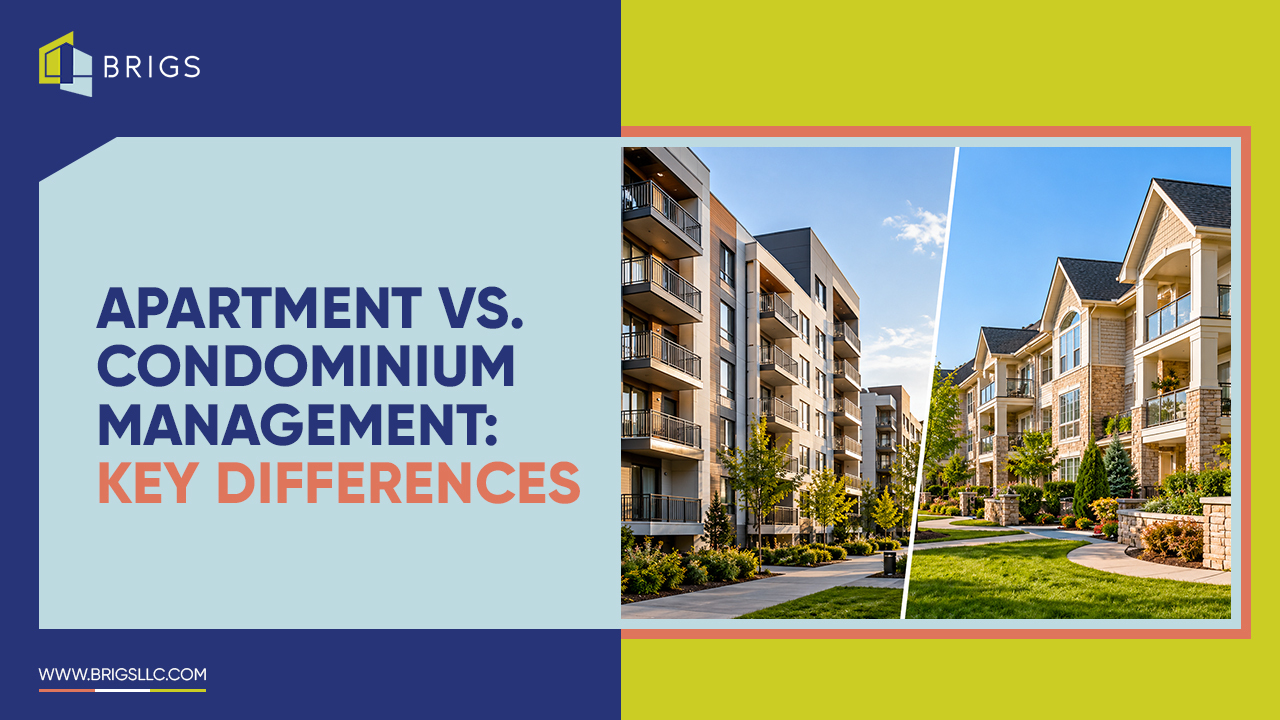
Apartments and condominiums can look very similar from the outside. Both may include hundreds of residential units, shared amenities, common areas, parking facilities, building systems, landscaping, maintenance requirements, and residents who expect their community to operate efficiently.
From a property management perspective, however, they can be very different.
The primary distinction comes down to ownership and governance. In a traditional apartment community, the property is generally owned by a single individual, company, partnership, or investment group. Residents rent their individual units, and the property management company typically operates the community on behalf of that ownership.
In a condominium community, individual units are typically owned separately. Unit owners collectively share an interest in common elements of the property, and an association is responsible for managing those shared responsibilities. An elected board generally provides governance and makes decisions on behalf of the association, while the property management company helps implement those decisions and manage day-to-day operations.
That difference in ownership changes nearly every aspect of the management relationship.
For an apartment property manager, there is typically a much clearer ownership structure. The owner establishes the property’s financial and operational objectives, and management executes against those priorities. Decisions involving rents, capital improvements, amenities, vendor contracts, maintenance standards, and property investments ultimately flow back to the property’s ownership.
Condominium management introduces another layer.
The management company is working with a board whose members are themselves unit owners and representatives of the larger association. Board members may change over time, may have different priorities, and often need to reach collective decisions before significant actions can be taken.
As a result, condominium property management requires significant coordination between the management company, board, individual owners, residents, vendors, and other professionals supporting the association.
Financial management also works differently.
Apartment communities operate as income-producing properties. Ownership typically evaluates revenue from rents against operating expenses, maintenance costs, capital expenditures, financing obligations, and other expenses associated with owning the property. Decisions may be influenced by occupancy, rental rates, operating income, property value, and the owner’s broader investment strategy.
A condominium association does not operate under the same model. Its primary source of operating revenue generally comes from assessments paid by unit owners. Those assessments fund the association’s operating expenses, maintenance responsibilities, insurance, vendor contracts, reserve contributions, and other community obligations.
That makes annual budgeting particularly important.
The board and management company need to determine what it will realistically cost to operate the property while also preparing for future needs. Keeping assessments artificially low may be attractive in the short term, but it can create financial pressure if the association does not adequately fund maintenance or reserves.
Reserve planning is therefore a significant component of condominium management.
Roofs, elevators, pavement, mechanical equipment, façades, common areas, and other major building components eventually require significant repair or replacement. Associations need to anticipate those expenses and establish a financial strategy for addressing them.
A well-managed condominium community should therefore be thinking not only about this year’s operating budget, but also about what the property may require five, ten, or even twenty years into the future.
Apartment owners face many of the same physical capital needs, but the funding and decision-making process is different. Ownership can determine how and when capital will be invested based on its financial resources, financing strategy, investment objectives, and assessment of the property.
In a condominium association, a major capital project may involve reserve funds, increased assessments, special assessments, financing, or a combination of funding strategies. The board may need to evaluate the available options, communicate with owners, consult professional advisors, and make decisions that affect every unit owner financially.
Maintenance responsibilities can also be considerably more complicated in condominium communities.
In an apartment building, the ownership entity generally has responsibility for the property and the units, subject to the lease and applicable requirements. When a resident reports a maintenance issue, management can typically evaluate the problem and coordinate the appropriate repair on behalf of ownership.
In a condominium, responsibility may depend on where the problem originated, what property component is involved, and what the governing documents establish.
A plumbing problem, for example, may involve an individual unit component, a common building system, or conditions affecting multiple units. A window, balcony, HVAC component, pipe, door, or other element may fall under the responsibility of the individual owner, the association, or potentially different parties depending on the specific circumstances and governing documents.
The property manager cannot simply assume that every problem occurring within the community is an association responsibility.
Management may need to review governing documents, coordinate inspections, communicate with individual owners, involve contractors, and sometimes work with insurance professionals or legal counsel to determine how a situation should be handled.
This makes documentation particularly important.
Condominium managers need access to governing documents, maintenance histories, contracts, insurance information, board decisions, vendor records, financial reports, and other information necessary to understand the association’s responsibilities.
Governance creates another major distinction.
Apartment residents are customers of the property’s ownership. They may provide feedback, submit maintenance requests, raise concerns, and communicate with management, but they generally do not collectively govern the property.
Condominium owners do.
The board is elected to represent the association and make decisions within the authority established by the governing documents and applicable requirements. Management supports that process by providing information, coordinating meetings, implementing board decisions, managing vendors, preparing financial information, communicating with owners, and helping maintain continuity as board membership changes.
That creates a fundamentally different management dynamic.
A condominium property manager may need to present multiple contractor proposals to the board, explain the implications of different options, answer questions, obtain approval, and then coordinate implementation. The manager is not simply executing an owner’s direction. The manager is supporting a governance process.
Communication also takes on greater importance.
In an apartment community, management communicates with residents about matters such as maintenance, rent, policies, amenities, inspections, and property operations.
Condominium management includes many of those same communications, but there is also an ownership component. Unit owners may want to understand budgets, assessments, reserve funding, capital projects, insurance matters, board decisions, vendor contracts, and long-term property planning.
Residents and owners may also be different people if individual condominium units are rented.
Management may therefore need to communicate with an owner about financial or association matters while communicating separately with a tenant occupying that owner’s unit about operational issues affecting the property.
Major projects illustrate many of these differences particularly well.
Suppose an aging roof needs to be replaced.
At an apartment property, ownership can evaluate the project, determine how it will be funded, select the appropriate contractor, and direct management to coordinate the work.
At a condominium, the process may involve management, the board, engineers or other consultants, multiple contractor proposals, reserve funding considerations, board approvals, owner communications, and potentially a special assessment or financing strategy if sufficient funds are not available.
The physical project may be essentially the same.
The management process surrounding it can be considerably different.
This is why managing a condominium should not simply be viewed as managing an apartment building where the residents happen to own their units.
Condominium management combines property operations with association governance, shared financial responsibility, owner communication, governing documents, reserve planning, and collective decision-making.
Both apartment and condominium management require strong operational capabilities. Buildings still need to be maintained. Vendors still need to perform. Emergencies still need to be handled. Budgets still need to be managed. Residents still need communication.
But the structure surrounding those responsibilities is different.
Understanding those differences is important when selecting a property management company.
A company managing condominium associations needs more than experience operating residential buildings. It needs processes for working effectively with boards, supporting association finances, coordinating meetings, managing owner communications, maintaining documentation, overseeing capital projects, and navigating the sometimes complex division of responsibility between individual owners and the association.
Ultimately, the distinction between apartment and condominium management is not primarily about the physical property.
It is about who owns it, who makes decisions, who is financially responsible, and how management works within that structure.
Those differences shape nearly every aspect of how the community is managed.
One of the most significant differences between apartment and condominium management is how decisions are made. While the day-to-day responsibilities of maintaining the physical property may overlap, the people with authority to make financial and operational decisions are often very different.
In an apartment community, the management company generally reports to a single ownership entity. That may be an individual investor, real estate company, partnership, institutional owner, or other organization. Ownership establishes the property’s objectives and gives the management team authority to operate within an agreed-upon framework.
This can make many decisions relatively straightforward. If a major HVAC system needs to be replaced, management can present the issue to ownership, provide recommendations and pricing, receive authorization, and move forward. If ownership wants to renovate common areas, introduce a new amenity, change a vendor, or invest in building improvements, the decision can generally be made according to the owner’s priorities and financial strategy.
Condominium management operates within a different decision-making structure.
Instead of reporting to a single property owner, the management company typically works with an elected board representing the condominium association. The board is responsible for making many of the significant decisions affecting the community, while the management company provides professional guidance and implements those decisions.
This introduces a governance component that does not typically exist in conventional apartment management.
Board members may have different opinions about what the community needs, how much should be spent, which projects should take priority, or how aggressively the association should prepare for future expenses. Reaching a decision may require discussion, review of multiple options, professional recommendations, and formal board action.
The property manager plays an important role in helping that process function effectively.
Management may identify a problem, gather information, obtain contractor proposals, consult with engineers or other professionals, explain the available options, and provide a recommendation. The board can then use that information to make a more informed decision.
The distinction between advising and deciding is important.
A professional condominium manager should bring experience and recommendations to the board, but many significant decisions ultimately belong to the board itself. Management then becomes responsible for carrying out the board’s direction and coordinating the operational work necessary to implement it.
Consider a community where the parking lot has deteriorated significantly. Management may recognize the condition, recommend that the board begin evaluating replacement, obtain preliminary pricing, and explain the potential consequences of continuing to defer the work.
The board may then need to determine whether the project should proceed immediately, whether additional engineering input is necessary, how the project should be funded, and how it fits alongside other capital priorities.
If the project moves forward, management may coordinate proposals, contractor scheduling, resident communication, parking arrangements, project oversight, invoicing, and other logistical requirements.
The physical problem is pavement deterioration. The management responsibility extends far beyond arranging for someone to repave the parking lot.
This governance structure can also make long-term planning more complicated.
Apartment ownership can establish a multi-year capital strategy and continue pursuing that strategy as long as ownership’s priorities remain consistent. Condominium boards, however, change over time. New directors are elected, officers change, and priorities can shift.
A project considered important by one board may be viewed differently by the next.
That makes documentation and long-term planning particularly important in condominium management. Reserve studies, engineering reports, maintenance histories, capital plans, meeting records, financial reports, and other documentation can provide continuity even as the people serving on the board change.
Without that institutional history, each new board may find itself revisiting issues that have already been studied extensively.
Strong property management can help maintain that continuity.
Management should be able to explain not only what issues currently exist, but also what has previously been evaluated, what professionals have recommended, what actions have already been taken, and what future needs have been identified.
This becomes especially important when a community faces difficult financial decisions.
A board may prefer to keep assessments low, particularly when residents are already concerned about increasing costs. However, management may have information showing that insurance expenses are increasing, reserves need additional funding, or major capital projects are approaching.
The property manager’s role is not simply to produce the budget the board would most like to see.
It is to provide the information necessary for the board to understand the potential consequences of different choices.
If reducing reserve contributions helps avoid an assessment increase today but leaves the association less prepared for a major roof replacement several years from now, that tradeoff should be clear. If delaying preventive maintenance creates a greater risk of expensive emergency repairs, the board should understand that as well.
This advisory role is one of the defining characteristics of effective condominium management.
Communication between the board and management therefore needs to be particularly strong.
Board members should understand which issues require their attention and which can be handled through the management company’s normal operating authority. If every routine maintenance decision requires board approval, the management process can become unnecessarily slow and burdensome.
At the same time, management should not make significant decisions outside the authority it has been given.
Clearly defined responsibilities allow both parties to operate more effectively.
Management can handle routine operations, coordinate vendors, respond to residents, monitor maintenance, and manage established processes without involving the board in every detail. The board can focus its attention on governance, financial oversight, policies, significant contracts, major projects, and long-term planning.
When those roles become blurred, frustration can develop on both sides.
A board that becomes deeply involved in day-to-day operations may unintentionally make it more difficult for management to perform efficiently. A management company that does not provide enough information may cause the board to feel that it needs to become more involved simply to understand what is happening.
Transparency helps create the appropriate balance.
Regular reporting, clear recommendations, documented project updates, financial information, and consistent communication allow the board to maintain oversight without needing to manage every operational detail.
Condominium managers also need to recognize that board members are typically volunteers.
They may have professional careers, families, and other responsibilities outside the association. Most did not join the board because they wanted to become experts in roofing systems, insurance markets, reserve funding, construction contracts, or building operations.
They rely on professional management and other advisors to help them understand complicated issues.
That means information needs to be presented in a way that supports decision-making.
Providing a board with three contractor proposals and asking members to select one may not be sufficient. Management should help identify meaningful differences in scope, pricing, qualifications, exclusions, and other considerations so the board understands what it is evaluating.
The same principle applies to budgets, insurance decisions, maintenance recommendations, and capital projects.
The value of condominium management is not simply administrative execution. It includes helping volunteer board members navigate the increasingly complex responsibilities associated with operating and protecting a shared property.
Apartment management requires professional expertise as well, but the relationship with ownership is fundamentally different.
In both cases, management’s objective is to operate the property effectively.
The difference is the decision-making framework surrounding that objective.
Understanding that framework is essential because successful condominium management requires a company that knows how to work within a community governance structure, maintain continuity as boards change, provide meaningful professional guidance, and turn board decisions into effective property operations.
The financial responsibilities involved in apartment and condominium management can look similar at first. Both types of properties require operating budgets, vendor payments, maintenance expenditures, insurance, utilities, staffing, and long-term investments in the physical property. The fundamental difference is where the money comes from, who controls it, and how financial decisions are made.
An apartment community is generally operated as an investment property. Rental income provides the primary source of revenue, while ownership is responsible for the expenses associated with operating and maintaining the property. The management company typically prepares budgets, monitors expenses, collects rent, manages vendor payments, and provides financial reporting to ownership. Decisions about major investments ultimately belong to the property owner, who can evaluate them within the context of the property’s overall investment strategy.
A condominium association operates differently. Rather than generating revenue primarily through rent, the association relies on assessments paid by individual unit owners to fund its responsibilities. Those funds need to cover current operating expenses while also helping the community prepare for future property needs. Management therefore works with the board to develop a budget that reflects both the cost of operating the community today and the financial obligations the association may face in the years ahead.
This creates an important distinction in how budgets should be evaluated. For an apartment owner, financial performance is typically considered alongside rental revenue, occupancy, operating expenses, capital expenditures, and the owner’s investment objectives. A condominium association is not primarily trying to generate a financial return. Its financial objective is to collect and maintain sufficient resources to responsibly operate, maintain, and preserve the shared property.
That makes assessment levels an important part of condominium financial management. Boards understandably want to keep costs manageable for owners, but assessments need to reflect the actual expenses associated with the community. Insurance premiums may increase. Utilities may become more expensive. Vendor contracts may rise. Aging buildings may require more maintenance, and reserve contributions may need to increase as significant capital projects approach.
Keeping assessments artificially low can create financial pressure elsewhere. Necessary maintenance may be deferred, reserve contributions may be reduced, or the association may become increasingly dependent on special assessments when major expenses occur. A lower assessment today does not necessarily mean a lower cost of ownership over the long term.
This is where reserve planning becomes particularly important. Condominium associations are responsible for major shared components that will eventually require significant repair or replacement. Depending on the property, those responsibilities may include roofs, elevators, façades, mechanical systems, pavement, common areas, structural components, and other major assets. A well-managed association should be preparing financially for those needs long before the work begins.
Reserve studies can provide an important framework for that planning by identifying major components, estimating their remaining useful lives, projecting future replacement or repair costs, and helping the association evaluate appropriate funding levels. Management can then work with the board to incorporate those anticipated needs into the community’s broader financial strategy.
The challenge is that long-term capital needs and annual budgets cannot be considered separately. A board might be able to reduce the proposed budget by lowering a reserve contribution, but doing so does not eliminate the future project the reserve contribution was intended to fund. It simply changes how prepared the association may be when that expense eventually arrives.
Strong condominium management helps boards understand those tradeoffs. The property manager should be able to connect current financial decisions with future property needs so that board members are not evaluating individual numbers without understanding their broader implications.
Capital projects further illustrate the financial differences between apartment and condominium management. If an apartment building needs a major roof replacement, ownership determines how to fund the project. The owner might use available cash, obtain financing, adjust other capital expenditures, or make an additional investment in the property.
A condominium association may have several different considerations. If reserves are sufficient, the project may be funded largely or entirely from existing funds. If they are not, the board may need to consider a special assessment, increased assessments, financing, phased work, or some combination of approaches. Those decisions can have a direct financial impact on dozens or hundreds of individual owners.
That makes early planning particularly valuable. The earlier an association understands that a major expense is approaching, the more opportunity it has to prepare. Reserve contributions can potentially be adjusted gradually, professional evaluations can be obtained, project costs can be investigated, and different funding strategies can be considered before the need becomes urgent.
Financial transparency is also especially important in condominium communities because the people funding the association are individual owners. Owners may reasonably want to understand why assessments are increasing, why a special assessment is necessary, or why the association is spending a significant amount on a particular project.
Management and the board should be prepared to provide that context. If insurance costs increased significantly, owners should understand the impact. If a reserve study identifies a substantial future funding need, that information should be communicated appropriately. If a capital project is necessary because a major building component has reached the end of its useful life, owners should understand the relationship between the project’s cost and the physical condition of the property.
This does not mean every owner will agree with every financial decision. Condominium communities include owners with different financial circumstances, priorities, and perspectives. Some may prefer to invest aggressively in the property, while others may prioritize keeping assessments as low as possible.
The board still has a responsibility to make decisions based on the needs of the association and the property as a whole.
The property manager’s role is to help make those decisions more informed. That includes providing accurate financial reporting, monitoring budgets, identifying meaningful variances, tracking vendor expenses, supporting reserve planning, and bringing emerging financial concerns to the board’s attention.
It also means looking beyond whether the association has enough cash to pay today’s bills. A community can appear financially stable in the short term while simultaneously becoming less prepared for future obligations. Strong financial management considers both perspectives.
Apartment owners also need to plan for future capital needs, but they generally have greater control over the timing and structure of those financial decisions because ownership is centralized. Condominium associations must balance the physical needs of the property with collective funding, board governance, reserve planning, and the financial impact on individual owners.
That makes financial management one of the clearest distinctions between the two models.
In both apartment and condominium management, the numbers matter. But in condominium management, those numbers are also closely connected to governance, owner communication, and the long-term financial health of the entire community.
Another major difference between apartment and condominium management is determining who is responsible for maintenance and repairs. In an apartment community, the ownership structure generally makes this relatively straightforward. The property owner is responsible for maintaining the building and its systems, while residents may have certain responsibilities established through their leases. When something breaks, management can typically evaluate the issue, determine the appropriate repair, and coordinate the work on behalf of ownership.
Condominium communities introduce a much more complicated division of responsibility. Individual owners are responsible for their units, while the condominium association is responsible for common elements and other components defined within the governing documents. Depending on the property, there may also be limited common elements that serve particular units but remain subject to specific association or owner responsibilities.
This means the location of a problem does not always determine who is responsible for fixing it.
A water leak inside a condominium unit provides a common example. The resident experiencing the leak may understandably contact management because water is entering their home. But determining responsibility may require identifying where the water originated, what building component failed, whether that component belongs to the association or an individual owner, and what the governing documents say about maintenance and repair responsibilities.
A leak originating from a common plumbing riser may be handled differently from a failed fixture inside an individual unit. Water entering around a window could involve an owner-maintained component, an association-maintained exterior component, or multiple conditions that need to be investigated before responsibility can be established.
The property manager’s job is not simply to dispatch a contractor. Management may first need to understand what happened and which party is responsible for addressing it.
The same complexity can apply to HVAC equipment, balconies, terraces, windows, doors, plumbing lines, electrical systems, roofs, parking areas, and other property components. Two condominium communities that appear physically similar may allocate these responsibilities differently based on their governing documents.
This is why condominium management requires a strong understanding of each association’s specific structure.
A management company should not assume that because a particular repair was an association responsibility at one property, it will automatically be handled the same way at another. The condominium’s governing documents need to inform the management process, with legal counsel or other appropriate professionals involved when interpretation is required.
This division of responsibility can also make resident communication more challenging.
From an owner’s perspective, the distinction between association and individual responsibility may not always be obvious. A resident may report a problem to management expecting the association to repair it, only to learn that the condition involves a component for which the individual owner is responsible.
How that information is communicated matters.
Simply telling an owner, “That’s not our responsibility,” may technically address the question but does little to help the resident understand what happens next. A stronger management approach explains what has been determined, why the issue appears to fall under the owner’s responsibility when appropriate, and whether any additional coordination with the association is necessary.
There may also be situations where responsibilities overlap.
A problem originating within an individual unit can affect common property or neighboring units. A common-element failure can damage privately owned areas. An insurance claim may involve the association’s policy, an owner’s policy, or both. Emergency conditions may require immediate action before responsibility for the ultimate cost has been fully determined.
In these situations, protecting the property may need to come first.
If water is actively flowing into multiple units, management’s immediate priority may be stopping the source and limiting additional damage. Questions about responsibility, insurance, reimbursement, and final costs can be addressed once the emergency has been stabilized and the relevant facts are available.
That requires judgment and coordination.
Condominium property managers may need to communicate with multiple owners, restoration contractors, plumbers, insurance professionals, board members, and other parties during a single incident. Clear documentation becomes essential because decisions made during the initial response may later become relevant to insurance claims, repair responsibilities, or financial discussions.
Apartment management can certainly involve complex maintenance situations as well, particularly in large properties. The difference is that management is generally coordinating those issues on behalf of one ownership entity. There may be questions about resident responsibility or insurance, but the underlying ownership of the building is more centralized.
In a condominium community, the manager is frequently coordinating between multiple property interests within the same physical building.
This distinction becomes even more important during major capital projects.
A condominium association may be responsible for replacing a roof, restoring a façade, modernizing elevators, repaving common parking areas, or replacing major mechanical equipment. Those projects can affect every owner even though the work may not occur inside every individual unit.
Management needs to coordinate the physical project while also navigating board approvals, funding, resident access, contractor requirements, communications, and potentially individual owner concerns.
Some projects may require access through privately owned units. Others may temporarily restrict balconies, parking spaces, entrances, elevators, or common areas. Owners may need to prepare their units before work begins or provide access at specific times.
The management challenge is therefore both operational and organizational.
Preventive maintenance can also be more complicated because association-maintained and owner-maintained components sometimes interact. An owner may be responsible for maintaining one component while failure to do so could eventually affect common property or neighboring units.
Clear policies and communication can help reduce these risks.
Owners should understand which maintenance responsibilities belong to them and which belong to the association. Management should understand when the association has authority or responsibility to inspect, maintain, or address particular conditions. When the distinction is unclear, appropriate professional guidance should be obtained rather than relying on assumptions.
This is another reason documentation is so important in condominium management.
Management needs access to governing documents, previous board decisions, maintenance histories, inspection reports, vendor records, insurance information, and correspondence related to significant property issues. That history can provide valuable context when similar situations arise in the future.
It can also create consistency.
If similar maintenance issues are handled differently from one owner to another without a legitimate reason, residents may perceive the process as unfair. A documented framework based on the governing documents and established association procedures helps management respond more consistently.
For property owners considering a condominium management company, this capability should not be overlooked.
Managing the physical building is only part of the responsibility. The management company also needs to understand how ownership boundaries, association responsibilities, governing documents, insurance considerations, board authority, and individual owner obligations intersect with the maintenance process.
The best condominium managers recognize that a maintenance request is not always simply a maintenance request.
Sometimes it is also a governance issue, an insurance issue, an ownership issue, a communication issue, or a combination of all four.
Understanding those distinctions—and coordinating the appropriate response—is one of the key differences between managing a condominium community and managing a traditional apartment property.
Apartment and condominium communities may share many of the same physical characteristics, but managing them effectively requires an understanding of the very different structures behind those properties. Ownership, governance, financial responsibility, maintenance obligations, and decision-making authority all influence how the management company needs to operate.
For apartment communities, management generally works on behalf of a centralized ownership entity. The owner establishes the property’s objectives, approves major investments, and ultimately controls decisions involving the asset. Management can focus on executing those priorities while overseeing residents, maintenance, vendors, finances, and day-to-day property operations.
Condominium management requires a broader approach.
The property manager is not working for a single owner who controls the entire building. Management is supporting an association made up of individual unit owners and working closely with an elected board responsible for governing the community. That introduces responsibilities that extend beyond traditional building operations.
A strong condominium management company needs to understand board governance, association finances, reserve planning, governing documents, owner responsibilities, meeting coordination, vendor oversight, capital projects, and resident communication. It also needs to understand how all of those responsibilities interact.
This becomes particularly important because many condominium decisions cannot be evaluated in isolation.
Consider a deteriorating roof. Physically, the solution may appear straightforward: determine the condition of the roof and, when appropriate, repair or replace it. From a condominium management perspective, however, the issue may involve much more.
Management may need to coordinate an inspection or engineering evaluation, help the board understand the findings, obtain proposals, evaluate available reserve funding, determine whether additional funding will be required, coordinate board approvals, communicate with owners, establish a construction schedule, oversee contractor activity, and manage resident disruptions throughout the project.
The roof is a physical asset.
Managing its replacement is an operational, financial, governance, and communication responsibility.
This is why condominium management experience matters.
A company may be very capable of maintaining an apartment building but still lack the processes necessary to support an association effectively. Responding to maintenance requests and coordinating vendors are important, but they represent only part of what a condominium board needs from its management partner.
Boards need a company that can help them make informed decisions.
That means identifying issues before they become emergencies whenever possible, providing useful financial information, maintaining accurate documentation, coordinating qualified vendors, tracking important projects, and helping the board understand the implications of different options.
It also means maintaining continuity.
Board members change. Vendors change. Residents move. Management personnel may transition. The needs of the property continue regardless of who is currently involved.
A well-managed condominium association should not have to reconstruct its history every time leadership changes.
Maintenance records, meeting documentation, financial reports, reserve studies, engineering evaluations, contracts, project histories, insurance information, and other important records should create an institutional history for the community. That information allows future boards and managers to understand what has already occurred and what may require attention next.
Communication is another important part of that continuity.
Condominium owners have a financial and ownership interest in the community, which means they often need information that extends beyond the typical resident communication found in an apartment property. They may need to understand upcoming capital projects, assessment changes, reserve funding, insurance issues, maintenance responsibilities, community policies, and board decisions.
That does not mean every owner participates directly in every management decision.
Effective condominium governance requires a clear distinction between the responsibilities of the board, management company, and individual owners.
The board governs the association and makes decisions within its authority. Management provides professional guidance and carries out the board’s direction. Individual owners fulfill their own responsibilities while electing board members to represent the association.
When those roles are understood, the community can operate more effectively.
When they are unclear, management can become unnecessarily complicated. Owners may expect the property manager to independently change a board policy. Board members may become involved in routine operational matters that management should handle. Management may receive conflicting instructions from individual directors.
Establishing clear roles and communication channels helps prevent those problems.
The relationship between the board and management company is therefore particularly important.
The strongest relationship is not one where the board simply delegates everything to management or one where the board attempts to manage every operational detail. It is a partnership in which responsibilities are clearly defined, information is shared appropriately, and each party understands its role.
Management should provide the board with visibility without overwhelming directors with unnecessary operational details. The board should provide direction and oversight without preventing management from performing the responsibilities it has been hired to handle.
That balance allows the property manager to focus on operating the community while the board focuses on governance and long-term direction.
For condominium associations evaluating a management company, the selection process should therefore extend beyond comparing management fees.
Boards should consider whether the company has experience managing properties with similar needs, how it approaches financial reporting and reserve planning, how maintenance and vendor performance are tracked, how major capital projects are coordinated, how resident communication is handled, and how the management team supports board decision-making.
Responsiveness matters, but so does proactivity.
A management company that responds quickly when something breaks provides an important service. A management company that helps identify the condition before failure, communicates the emerging risk to the board, develops options, and allows the association to prepare financially provides something even more valuable.
The same principle applies to finances. Producing monthly reports is important. Helping the board recognize a developing budget problem or future capital funding need makes those reports actionable.
Professional property management should help a community understand not only what is happening today, but what it should be preparing for next.
At BRIGS, we believe that distinction is particularly important in condominium management. Successful communities require more than day-to-day building operations. They require strong financial oversight, proactive maintenance, effective board support, accountable vendors, clear communication, detailed documentation, and thoughtful long-term planning.
Apartment and condominium management both require experienced professionals who understand residential properties.
But they are not interchangeable disciplines.
The ownership structure is different. The financial model is different. The decision-making process is different. Maintenance responsibilities can be different. The relationship between management and the people it serves is different.
Recognizing those distinctions is the first step toward selecting a management approach that fits the property.
For condominium boards in particular, the right management company should do more than manage the building.
It should help the board manage the responsibilities that come with governing and protecting the entire community.